
🌍 The Community Edition: Lean Teams, Wide-Open Agent Markets
February 27, 2026


It’s Friday, February 27th: Today we’re looking at why “staying small” has become the new signaling game for AI startups, where the rest of the agent market is still wide open beyond software engineering, and what that looks like on the ground from Midtown Manhattan to Atlanta to a room of 3,500 teenage girls in Utah.


Head over to our Events Portal to get the latest on upcoming AI Collective events near you. Search by city, date, or event format, and join thousands of builders at events across 100+ chapters on every continent (except Antarctica, for now).
🌁 Based in SF? Check out SF IRL, MLOps SF, GenerativeAISF, or Cerebral Valley’s spreadsheet for more!

1️⃣ When “Staying Small” Becomes the Signal

The Wall Street Journal tracks a growing pattern:
AI startups holding headcount flat while pushing revenue-per-employee higher, in some cases aiming for billion-dollar outcomes with teams that look more like a tight founding pod than a traditional org chart. Founders lean on AI coding tools, automated support, and AI-augmented GTM work so a few people can cover what used to require multiple specialized teams. The flex is efficiency: shipping fast, keeping burn low, and avoiding the managerial drag that comes with growing too early.
Why it matters:
For early teams, “small by design” is now a positioning choice. Investors are watching revenue-per-employee and operating leverage as closely as raw growth, which rewards founders who close loops with automation instead of headcount. But the piece also surfaces the downside risk: key-person fragility, burnout, and brittle systems where a handful of people know how everything works. The applied AI move is to use agents and workflows to absorb repeatable work while still investing in documentation, ownership boundaries, and real succession plans. If you’re building now, the question isn’t “How small can we stay?”—it’s “Where does AI carry the load, and where do we still need humans in the loop for resilience?”
2️⃣ Agents Own Dev Tools—Everything Else Is Greenfield
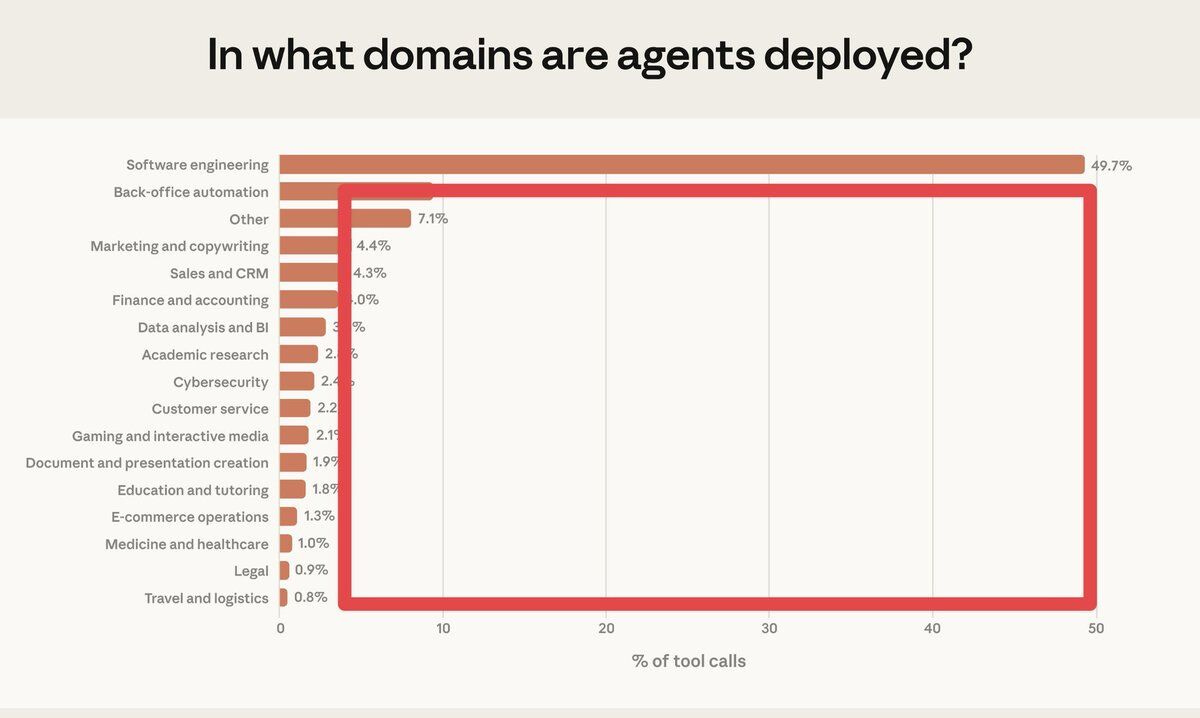
Garry Tan breaks down Anthropic’s latest agent usage data:
roughly 50% of all AI agent tool calls on their API are in software engineering, while 16 other verticals—healthcare, legal, finance, education, logistics, customer service, and more—each sit below 9%, many under 2%. The headline is that “agentic software” already has a clear wedge in coding workflows, but almost nowhere else is close to saturated. He connects this to two decades of SaaS growth and argues that every major SaaS category has a vertical AI successor waiting to be built, with agents that don’t just replace software, but also absorb parts of the operator’s work.
Why it matters:
If you’re still thinking about agents as a horizontal dev-tools story, this data is the nudge to pick a vertical. The opportunity is in workflows that mix proprietary data, domain-specific context engineering, and real change management for customers—where an agent can actually move a process end to end instead of just drafting text or code. The study also shows session lengths and turn durations stretching over time, which signals growing trust: users are letting agents run longer, more complex jobs. That’s a green light for founders to design deeper, higher-stakes automations, provided they invest in monitoring and post-deployment guardrails from day one.

Each week, we highlight AI Collective chapters doing groundbreaking work with their members around the world. Tag us on socials to be featured!
🍑 ATL | The AI Collective Social: Business Automation, Data Centers, Real Use Cases
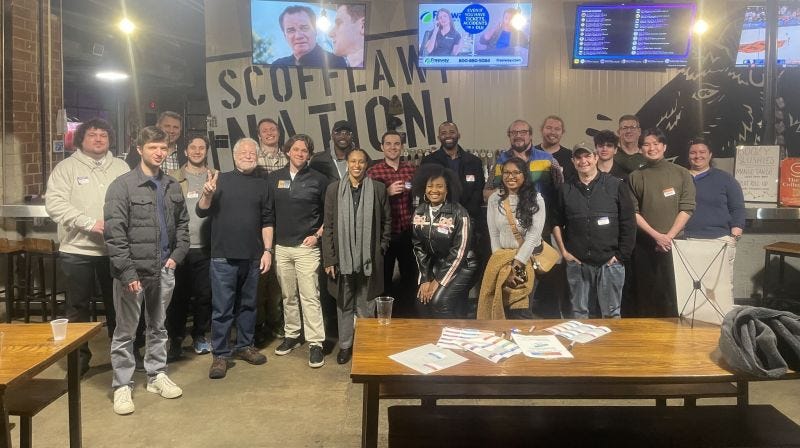
Dr. Scofflaw’s in West Midtown turned into a cross-section of Atlanta’s AI stack for an evening—small enough to keep conversations real, diverse enough that no two tables sounded the same. Builders and operators compared notes on end-to-end AI systems that automate business operations, from back-office workflows to customer-facing processes where latency and reliability actually matter.
The room moved quickly past “what model are you using” into “what does your full pipeline look like.” People traded approaches for using AI in event and community management, designing bespoke data center architectures for heavier workloads, and curating niche datasets aimed at financial market prediction rather than generic benchmarks.
🎓 UT | SheTech Explorer Day: 3,500 Girls, One Expo Hall, Future Builders
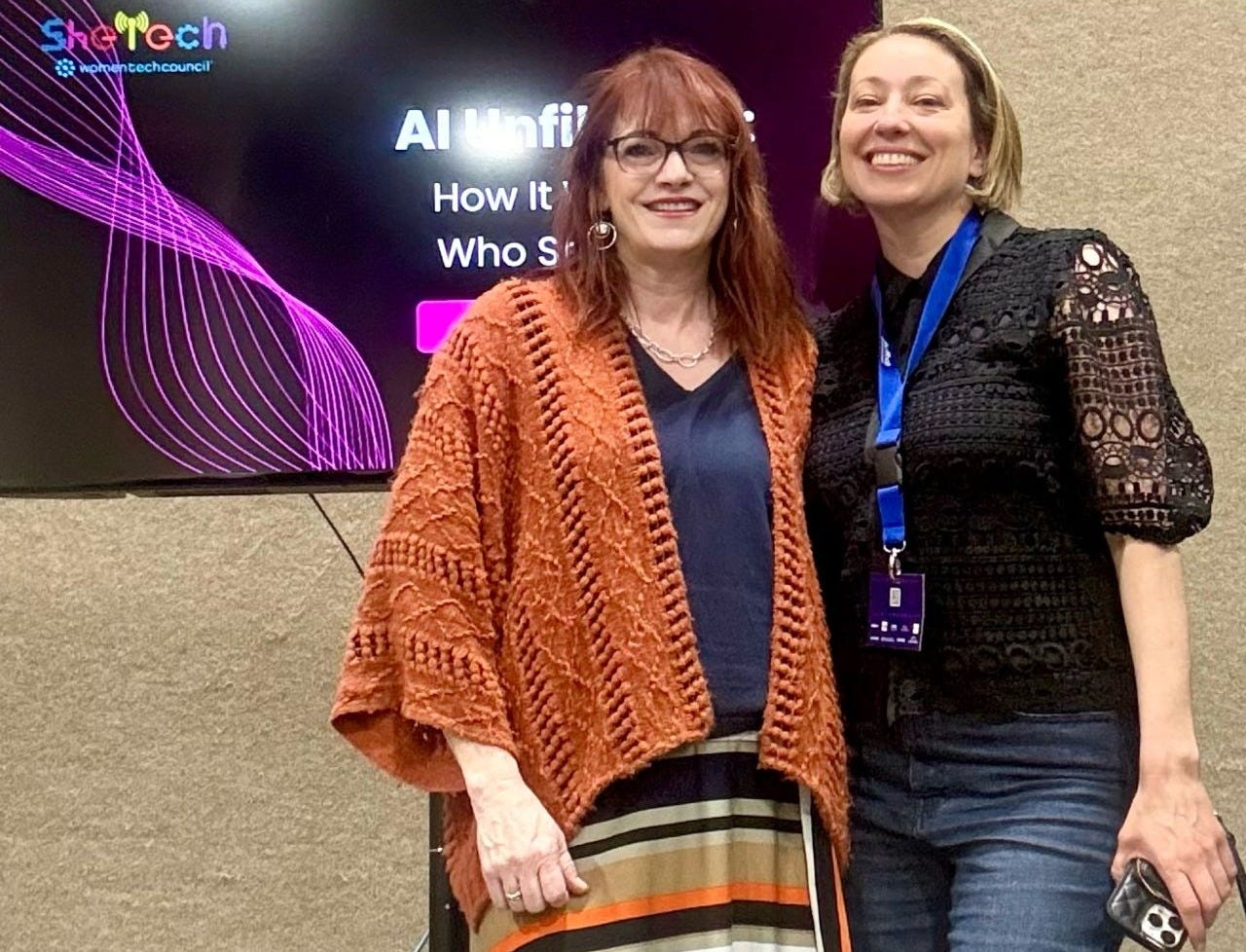
At the Mountain America Expo Center in Sandy, Utah, SheTech Explorer Day brought 3,500 high school girls from 150+ schools into one space for a focused look at what working in tech can actually mean. Across the day, students rotated through hands-on workshops, a crowded TechZone, and a TechChallenge that paired teams with industry mentors to solve real problems and pitch their solutions.
Even though the broader research shows women adopt AI more slowly than men, this room cut against the trend, by provoking thoughtful questions, clear opinions about how and when to trust systems, and curiosity about how AI shows up in everything from creative work to data-heavy roles. For the girls, it’s a concrete first pass at what a STEM path could look like, and for mentors and volunteers, it’s a reset on who the next generation of AI-native talent is and how quickly they’re already closing the gap.
📝 Community Notes
🌁 San Francisco Panel and Live Demo: IDE-Native AI Workflows (March 4)
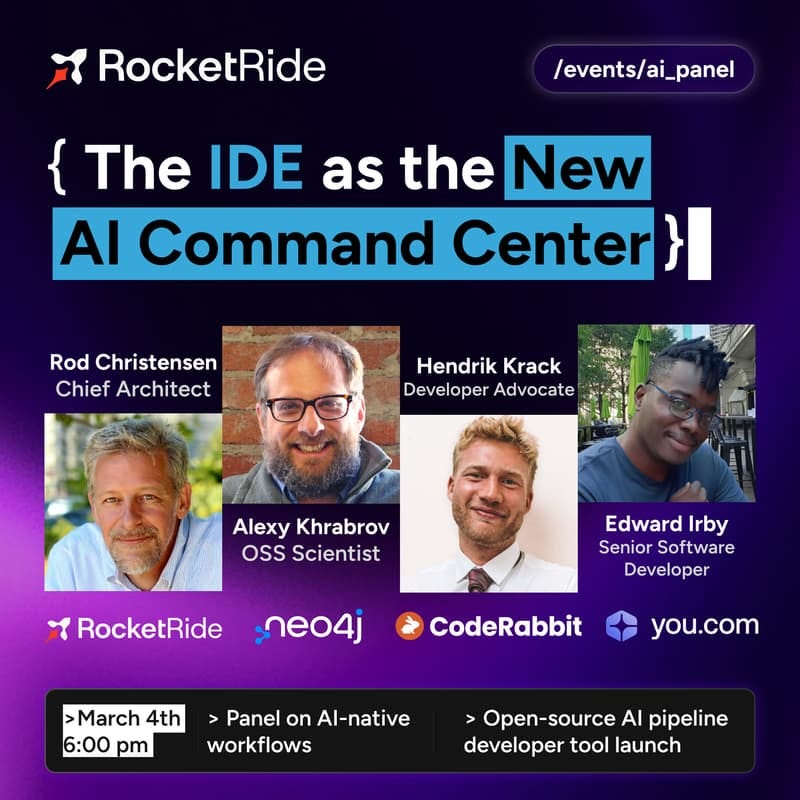
If you are building with LLMs, RAG, or AI features inside real products, this San Francisco event is designed for you.
On Wednesday, March 4, join a panel and audience Q&A on why the IDE is becoming the command center for AI development. Then watch a live technical demo where a production workflow is built directly inside VS Code and Cursor, end-to-end, with the same structure used for deployment. You will also get early access to a new open-source project from RocketRide and the chance to try it at demo stations. Dinner and snacks are included, plus time to meet other builders in the Bay Area.
If you cannot attend, join the project waitlist.
Our Premier Partner: Roam

Roam is the virtual workspace our team relies on to stay connected across time zones. It makes collaboration feel natural with shared spaces, private rooms, and built-in AI tools.
Roam’s focus on human-centered collaboration is why they’re our Premier Partner, supporting our mission to connect the builders and leaders shaping the future of AI.
Experience Roam yourself with a free 14-day trial!
➡️ Before You Go
Partner With Us
Launching a new product or hosting an event? Put your work in front of our global audience of builders, founders, and operators — we feature select products and announcements that offer real value to our readers.
👉 To be featured or sponsor a placement, reach out to our team.
The AI Collective is a community of volunteers, made for volunteers. All proceeds directly fund future initiatives that benefit this community.
Stay Connected
💬 Slack: AI Collective
🧑💼 LinkedIn: The AI Collective
𝕏 Twitter / X: @AICollectiveCo
Get Involved
About the Authors
About Joy Dong
Joy is a news editor, writer, and entrepreneur at the forefront of the emerging tech landscape. A former educator turned media strategist, she demystifies complex systems to make AI and blockchain accessible for all. Joy is on a mission to explore how decentralized technology and artificial intelligence can be leveraged to build a more innovative and transparent future.
About Noah Frank
Noah is a researcher, innovation strategist, and ex-founder thinking and writing about the future of AI. His work and body of research focus on aligning governance strategies to anticipate transformative change before it happens.